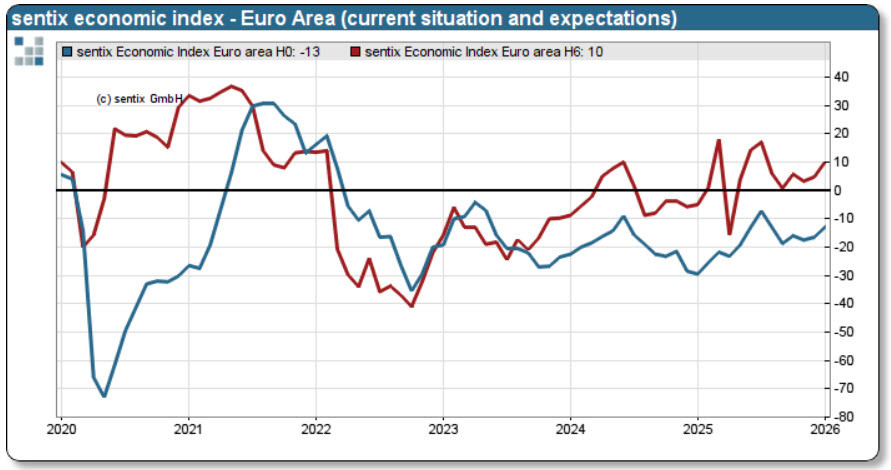
The Sentix investor confidence indicator rose by 4.4 points in January to -1.8, the highest level since July 2025. The index's increase is primarily due to a rise in expectations, which have become much more positive; the assessment of the current situation remains weak but also shows an upward trend.
Overall, investors have begun to view the eurozone's economic prospects more positively, which provides an additional supporting factor for the euro.
On the whole, the eurozone economy looks more convincing than was forecast six months ago. GDP growth exceeded forecasts and was practically unaffected by the introduction of new U.S. import tariffs; the composite PMI remained in expansion throughout last year, and the average value of the index for Q4 was 52.3 points, a high since 2023.
The last European Central Bank meeting of the previous year also added positivity: staff forecasts were revised upward across the entire projection horizon, and the 2026 inflation forecast was revised up, which has all but ruled out another possible ECB rate cut. Clearly, this dynamic could not fail to support the euro.
Inflation fell to 2.0% year-on-year in December, reaching the ECB's target. Core inflation decreased to 2.3%, and since energy prices have recently declined, the inflation forecast for Q1 was revised down to 1.6% year-on-year, which is noticeably below the ECB's projection and increases the likelihood of a rate cut. At the moment, this is the main factor slowing the euro's growth, since the dollar cannot yet provide convincing evidence in favor of its own appreciation.
ECB member De Guindos, commenting on the inflation data, noted that the target has been reached, but uncertainty remains very high. Revised inflation data will be published on January 20, and the January PMIs on January 21; until then, no significant eurozone data is expected to influence euro forecasts.
The net long position on the euro increased by $0.7 billion during the reporting week and reached $23.8 billion; the speculative bias toward the euro is at its highest level since mid-2023, which is somewhat surprising given the unevenness of economic growth in the eurozone.
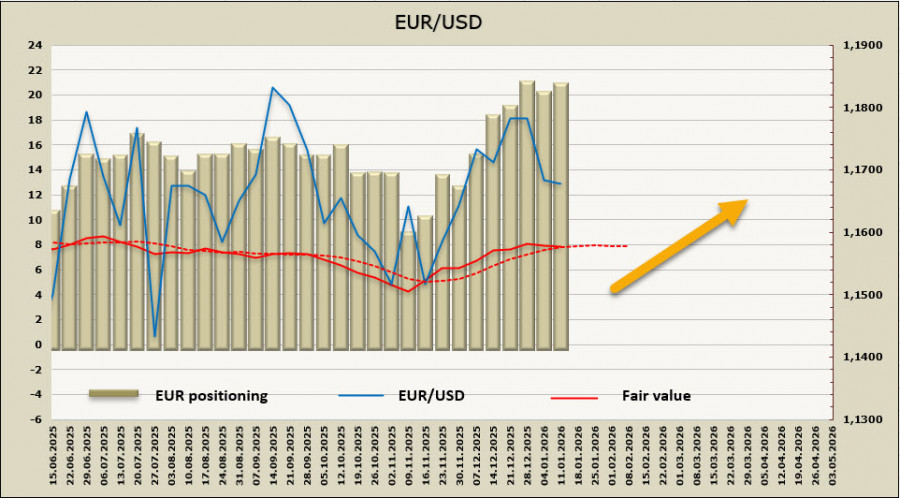
A week earlier, we expected that EUR/USD was close to completing its correction and resuming growth toward 1.1919; the euro fell slightly lower, but there are still no grounds to fear a reversal to the downside. Eurozone inflation in December was slightly below forecasts, which could have been a reason for euro selling due to fears of another ECB rate cut, but officials' comments calmed markets, and for the short term, that threat is absent. We expect growth to resume; the probability of a fall to the next support at 1.1520–1.1540 is low.