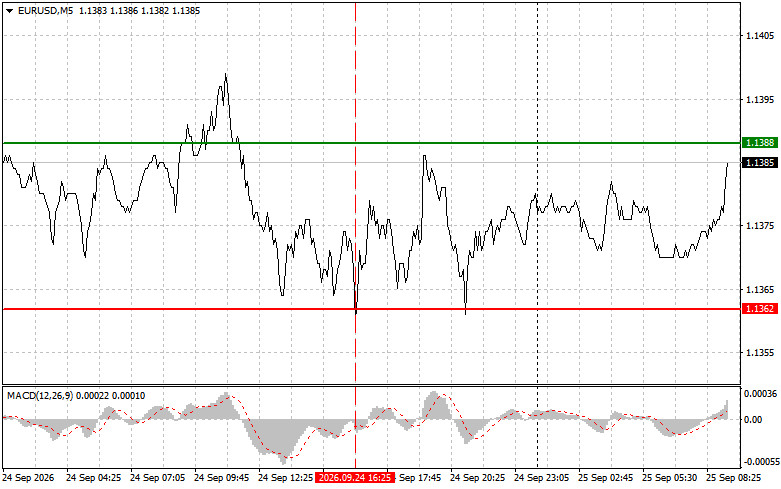
The price test at 1.1362 occurred as the MACD indicator began moving down from the zero line, confirming a correct entry point to sell the euro. However, the pair did not subsequently drop, which resulted in loss-taking.
US housing data yesterday were mixed: new-home sales in August jumped 6.4% month-on-month to a 684k annualized pace, while the median sale price plunged 9.1% to $478,700 and the months-of-supply fell to 8.5 from 9.0 in July. I view this combination more as a structural shift in demand toward cheaper housing amid high mortgage rates than as a full recovery of the sector. Labor-market data added further ambiguity: initial jobless claims fell to 197k, and the four-week average dropped to 202,250, whereas continuing claims edged up slightly to 1.719 million.
For the euro, the main takeaway was that the dollar failed to extract a clear advantage from this mixed data set, since both reports were too blended to materially alter Fed-rate expectations.
Today in the first half of the day, the euro will see a not-top-tier but interesting data block: GfK's leading German consumer sentiment index, eurozone private-sector lending figures, and M3 money-supply dynamics. None of these releases is a primary market mover, and I do not expect them to materially change the balance between buyers and sellers. Rather, I expect EUR/USD to trade within the existing sideways channel today. The GfK index only provides a rough read on German consumer sentiment, while lending and M3 figures are primarily useful for assessing how the private sector adapts to prior European Central Bank hikes, rather than serving as standalone FX drivers. Without a stronger signal from either Europe or the US, the pair will likely remain rangebound until a more significant catalyst appears.
For intraday strategy, I will mainly rely on Scenarios No. 1 and No. 2.
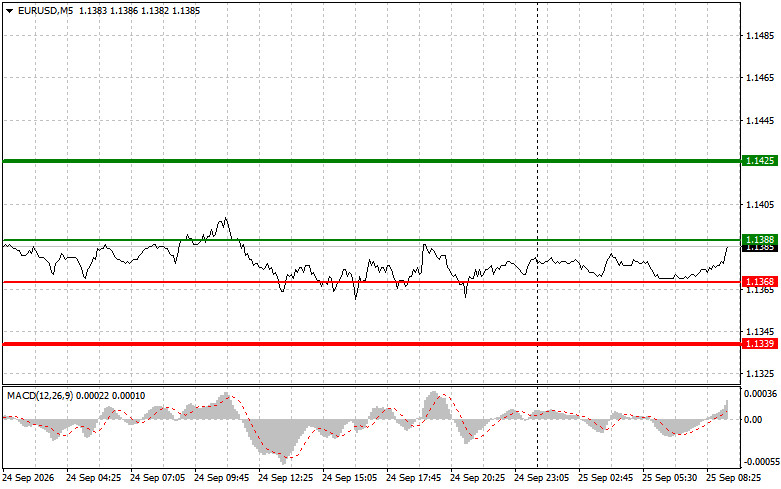
No 1: Buy the euro today around 1.1388 (green line on the chart), targeting 1.1425. I plan to exit at 1.1425 and then sell the euro in the opposite direction, targeting a 30–35 pip counter-move. Expect euro gains only after very strong data. Important: before buying, ensure the MACD is above zero and has just begun rising.
No 2: Also buy the euro if the price tests 1.1368 twice in a row while MACD is in the oversold area. This would limit downside potential and lead to an upward reversal. Expect moves to 1.1388 and 1.1425.
No 1: Plan to sell the euro after the 1.1368 level is reached (red line on the chart). The target will be 1.1339, where I plan to exit and immediately buy in the opposite direction (expecting a 20–25 pip counter-move). Pressure will return on weak data. Important: before selling, ensure the MACD is below zero and has just begun falling.
No 2: Also plan to sell the euro if the price tests 1.1388 twice in a row while MACD is in the overbought area. This would limit upside potential and trigger a reversal down. Expect declines toward 1.1368 and 1.1339.
Important: Beginner traders in the Forex market need to be very cautious when making entry decisions. It is best to stay out of the market ahead of significant fundamental reports to avoid being caught in sharp price fluctuations. If you decide to trade during news releases, always set stop orders to minimize losses. Without stop orders, you can quickly lose your entire deposit, especially if you do not employ money management practices and trade large volumes.
Also, remember that successful trading requires a clear trading plan, similar to the one provided above. Making spontaneous trading decisions based on current market conditions is inherently a losing strategy for intraday traders.