Markets resisted for a long time but have finally broken. At the outset of the armed conflict in the Middle East, investors were confident it would be short-lived. That made a buy-the-dip strategy in the S&P 500 feasible. However, time passed, the war did not end, and the broad equity index entered a correction as illusions were lost.
US equity markets are down for the fourth consecutive week, and in percentage terms, their rout is the largest since April. The driver is acute inflationary concern. On the one hand, this pushes up US Treasury yields, increases corporate costs and reduces earnings. On the other, it forces the Fed to contemplate tighter monetary policy. In 2022, the S&P 500 slid by 19% amid the oil shock and several federal funds rate hikes.
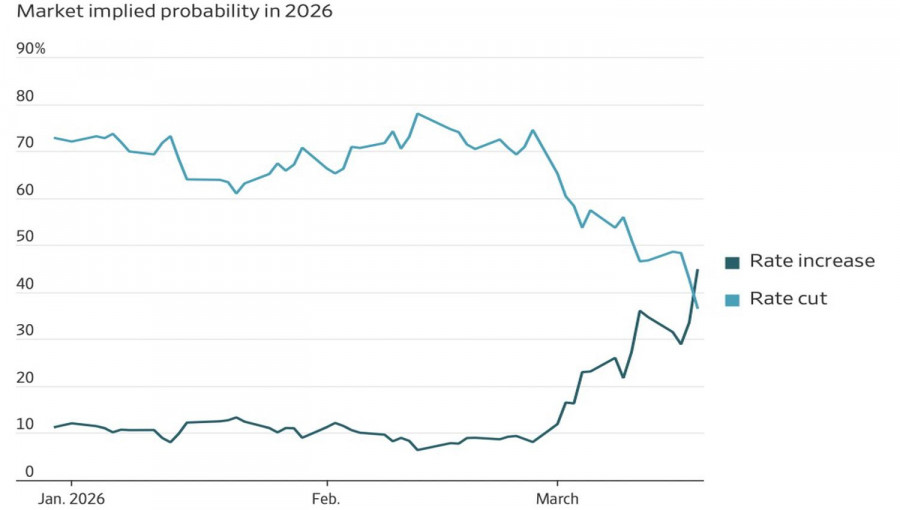
Dynamics of federal funds rate market expectations
If at the start of the year the futures market priced in a 72% probability of a rate cut and an 11% chance of a rate increase, by the end of the second decade of spring, those figures shifted to 37% and 45%. Derivatives are more confident in monetary tightening than in easing. This is putting pressure on US equities.
Against this backdrop, JP Morgan's downgrade of its S&P 500 target from 7,500 to 7,200, citing an oil supply shock threatening profits and economic growth, looks warranted. According to a Goldman Sachs survey, an increasing number of the bank's clients now expect a correction in the broad index. Those who had counted on a quick end to the US-Iran confrontation are beginning to seriously doubt it.
That is logical given Donald Trump's statement of reluctance to draw a line under the conflict and the increase in the number of US Marines in the Middle East. Although the White House is not talking about a possible ground invasion, the risks grow by the day.
Correlation dynamics: S&P 500 vs. Magnificent Seven
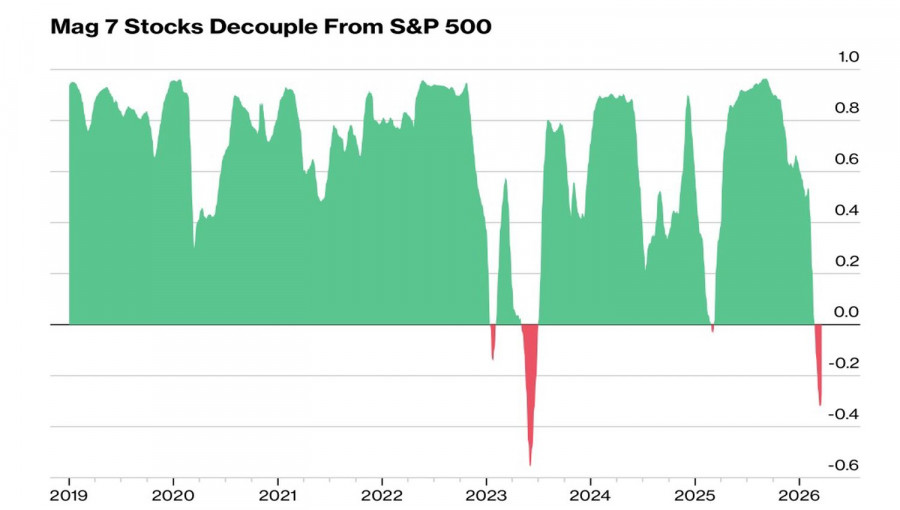
Meanwhile, the correlation between the Magnificent Seven stocks and the S&P 500 has turned negative for the second time in history. The first occurrence was in 2023, when the broad index was trying to recover from the sell-off, while Big Tech was buoyed by AI developments.
This time, the divergence reflects investors' belief that AI will offset geopolitical negatives. The Magnificent Seven are turning into a kind of refuge. What to do if gold and US Treasuries cannot perform these safe-haven functions? They are among the main victims of the Middle East conflict.
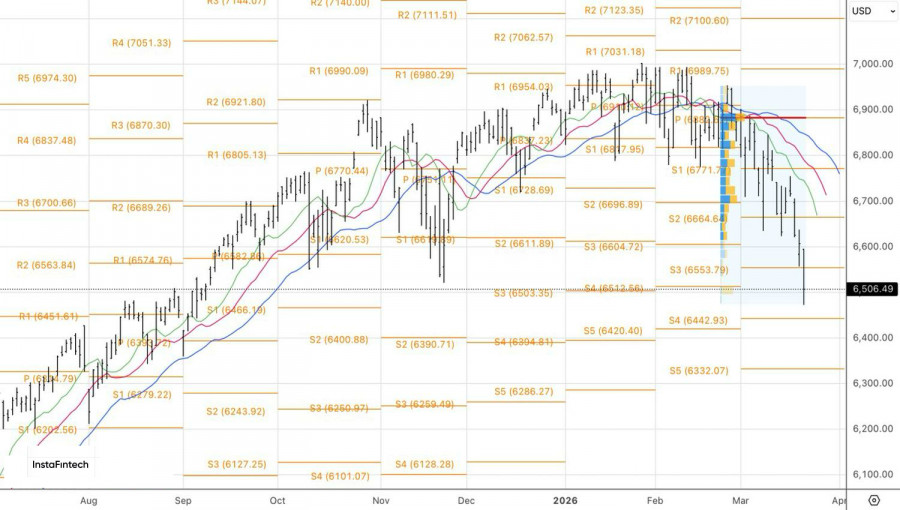
Technically, the S&P 500 is developing a corrective movement within the uptrend on the daily chart. The first of the two previously announced target levels at 6,510 and 6,390 has been reached. The broad index is confidently advancing toward the second target. It is quite possible the target will need to be shifted to 6,300. In these conditions, it is advisable to stick to a selling strategy.