Few macro releases are scheduled for Monday, and even fewer are important. Germany, the euro area, the U.K. and the U.S. will publish manufacturing-sector activity indices for October. However
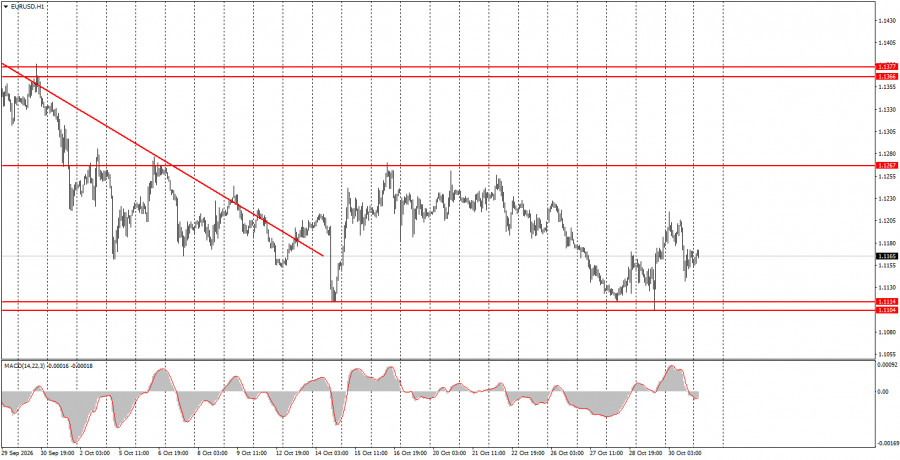
Few macro releases are scheduled for Monday, and even fewer are important. Germany, the euro area, the U.K. and the U.S. will publish manufacturing-sector activity indices for October. However, in all countries except the U.S., these will be second-estimates for October, whereas in the U.S. the ISM manufacturing index will be the single and most important reading. Therefore, we expect the market to react primarily to the U.S. ISM. Germany will also release a retail-sales report, but it is unlikely to attract traders' attention.
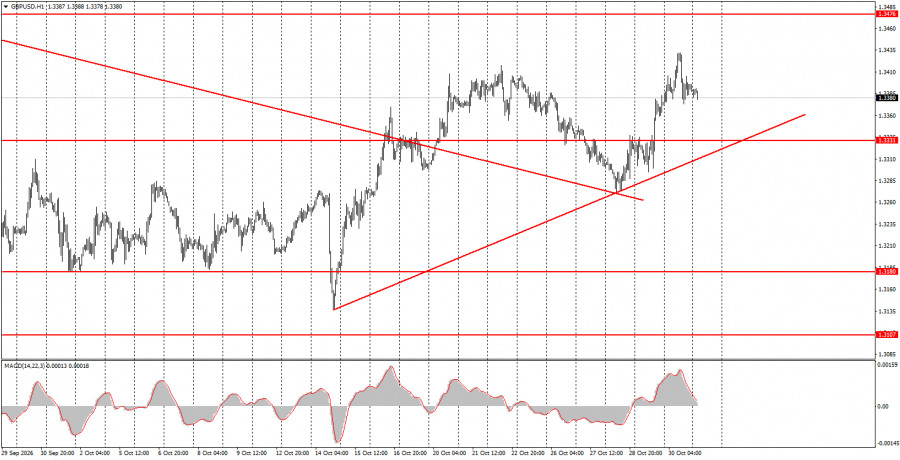
Among Monday's fundamental events, the only notable speaking slot is Federal Reserve Governor Austan Goolsbee. But recall that the policy path is clear to traders at least through the end of this year: the Fed is virtually certain (priced at near 99%) to deliver a second tightening in December, and that expectation has long been reflected in the dollar. U.S. inflation remains elevated, so the Fed has no obvious reason to abandon its hawkish stance.
The geopolitical backdrop remains poor. The U.S. and Iran are not conducting official talks, and Donald Trump keeps asserting a deal could be struck — the question is when. Reports suggest that right after the U.S. midterms, the U.S. and Israel could resume strikes on Iran if no agreement is reached; we consider that more likely than a ceasefire. Iran, in turn, is ready to resume strikes on U.S. allies in the region. In addition, mass unrest continues in many European countries, which does not add optimism for the euro. These two factors can support the dollar, although against the euro the dollar has been rising in any case, while versus the pound these factors have had little apparent impact.
Volatility may be fairly low on the first trading day of the week because, aside from the ISM index, there are no major events today. We expect the euro and the pound to continue their recent strength. Trade EUR/USD from the 1.1198–1.1218 area and GBP/USD from the 1.3380–1.3386 area.
Price levels (areas) of support and resistance — levels that serve as targets when opening longs or shorts or as sources of signals.
Red lines — channels or trendlines that display the current trend and indicate the preferred trading direction.
MACD indicator (14,22,3) — histogram and signal line — an auxiliary indicator that can also be used as a source of signals.
Important speeches and reports (listed in the news calendar) can strongly affect a currency pair's movement. Therefore, when they are released, one should trade as cautiously as possible or step aside to avoid a sudden price reversal against the prior direction.
Beginner forex traders should remember that not every trade can be profitable. Developing a clear strategy and money-management rules is the key to long-term success in trading.